Idea · Words and pictures
Words that turn the picture
A line of text contradicts or overturns what the picture seems to say.
It answers the question How do the words and the picture work on each other? Also called counterpoint or ironic caption.
What it does
Irony, critique, a second reading; the picture says one thing, the words another.
Words that turn the picture, put on a style
Each picture is a style from the atlas with this idea put on it, beside the same style as it is. All are AI-generated: none is a real or historical work.
-

As it is 
With words that turn the picture Karaoke Dynasty The line says he knew it by heart, and the words are written across his glasses.
-
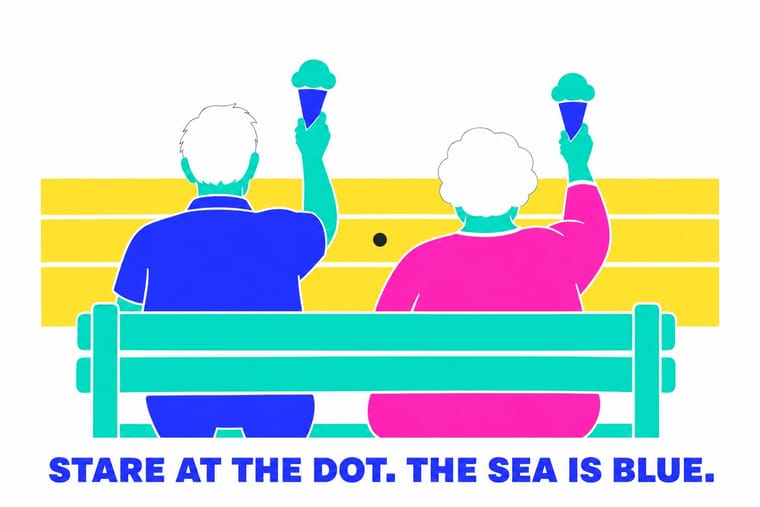
With words that turn the picture Afterimage The card says the sea is blue while it is plainly yellow, and it is right the moment you stare at the dot and look at the white.
Try it on any style
Pick a style, any style, and tell the image model:
Pair the picture with a short line of text that turns its meaning around.
Then write the idea in one sentence, saying what the picture shows and what that gets across. If the idea leans on the words, check it against them. A tap for the O in a headline that has no O breaks the word.
Mix styles writes the rest of the prompt for any style in the atlas, or a blend of a few. Add the line above and your sentence to it.
Where it has been used
Real works that use it, named so you can look them up. Stylogeny shows no pictures of them.
- René Magritte’s The Treachery of Images (1929)
- Barbara Kruger’s slogans over found photographs (1980s)
What it helps to say
It can argue
Styles known for it 5
These styles use it often. For those marked signature, it is part of what they are. Any other style can take it too.
- ACT UP & Gran Fury AIDS Activist Graphics signature A heavy Futura line turns a harmless photograph into a charge: 'Read My Lips' over two kissing sailors, 'Women Don't Get AIDS, They Just Die From It' over a line of beauty-pageant contestants.
- Israeli Political Poster (Tartakover to Lemel) signature Tartakover's Mi yimalel gevurot Yisrael (1982), made after the Sabra and Shatila massacres, lays a Hanukkah song's line on 'the mighty deeds of Israel' across a photograph of a distressed woman, so the heroic words turn bitter.
- Situationist Détournement Graphics signature Speech balloons are emptied and refilled with theory, so cowboys on horseback discuss reification in André Bertrand's Le Retour de la colonne Durutti (1966); captions are picked so their link to the picture is not obvious.
- Creative Revolution Print Advertising (Classic Long-Copy Ads) DDB's Volkswagen Lemon calls the Beetle in the photograph a lemon; the copy explains that an inspector rejected it for a blemished chrome strip, so the insult proves the care.
- Surrealist Graphics René Magritte sets a plain caption against the picture: 'Ceci n'est pas une pipe' under a pipe in The Treachery of Images (1929), or everyday objects given the wrong names in The Key of Dreams (1930).